

Mixed Reality Market Expected to Grow to USD 183.55 Billion, with a 39.8% CAGR by 2035
Mixed Reality Market
Mixed Reality Market is advancing through immersive applications in healthcare, education, gaming, manufacturing, training, and enterprise collaboration
Mixed Reality is reshaping digital experiences by blending physical and virtual environments to improve collaboration, training, visualization, and engagement.”
PARIS, PARIS, FRANCE, August 25, 2026 /EINPresswire.com/ -- The Mixed Reality Market is entering a high-growth phase as businesses and consumers increasingly combine physical environments with interactive digital content. Mixed reality (MR) brings together elements of augmented reality and virtual reality to create immersive experiences in which digital objects can interact with real-world surroundings. The technology is finding applications across gaming, healthcare, education, manufacturing, retail, defense, real estate, and professional training. Advances in spatial computing, artificial intelligence, 5G connectivity, edge computing, sensors, and display technologies are improving the usability and performance of MR devices. Enterprises are particularly adopting mixed reality for workforce training, remote assistance, product design, maintenance, simulation, and collaboration. — Market Research Future
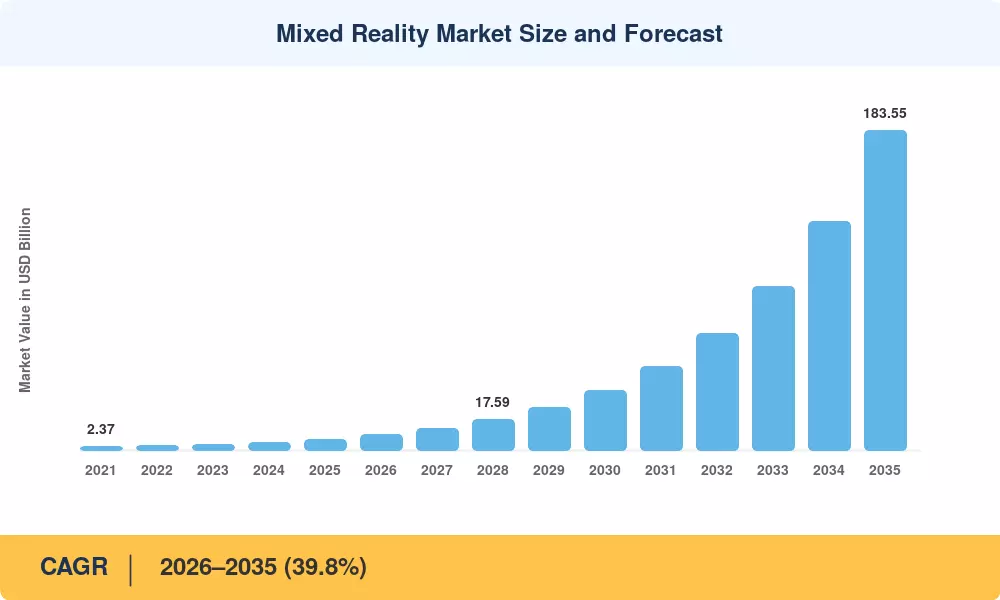
According to Market Research Future, the Mixed Reality Market reached USD 6.34 billion in 2025 and is projected to grow from USD 9.00 billion in 2026 to USD 183.55 billion by 2035, representing a 39.8% CAGR during the 2026–2035 forecast period. Enterprise immersive training and 5G-enabled edge computing are among the major factors supporting this expansion.
The market is also benefiting from the convergence of mixed reality with generative AI. AI-powered assistants can help users access information, understand physical objects, and receive contextual instructions through immersive interfaces. Meanwhile, improvements in passthrough displays, standalone headsets, spatial mapping, and real-time rendering are making MR experiences more practical for professional environments. The increasing availability of cloud-based platforms and subscription models is also helping organizations reduce upfront infrastructure investments. These developments are gradually shifting mixed reality from an emerging technology used primarily for experimentation toward a practical tool for enterprise productivity, training, design, and operational support.
Get a Sample PDF of the Report at -
https://www.marketresearchfuture.com/sample_request/1766
Market Dynamics: Drivers, Restraints and Opportunities:
The growing use of immersive training is a major driver of the Mixed Reality Market. Manufacturers, aerospace companies, defense organizations, and healthcare institutions can use MR simulations to provide employees with realistic training without requiring physical equipment or environments. Mixed reality can also support remote experts by allowing them to place digital instructions and annotations directly within a user's field of view. At the same time, 5G and edge computing are helping reduce latency, which is important for applications requiring precise digital overlays and real-time collaboration. The integration of generative AI is another important growth factor because AI can assist with content creation and provide contextual guidance during MR experiences.
However, high hardware prices remain a challenge for widespread adoption. Enterprise-grade headsets can require substantial investment, particularly when organizations also need software, content development, integration, and employee training. Limited field of view, battery constraints, fragmented content ecosystems, privacy concerns, and cybersecurity risks can also affect deployment decisions. Despite these restraints, opportunities are expanding through MR-as-a-Service, subscription-based hardware models, industrial digital twins, spatial analytics, remote expert assistance, and AI-powered inspection. These applications can make mixed reality more accessible while creating measurable business value across industries.
Key Players and Competitive Insights:
The Mixed Reality Market features major technology companies and specialized immersive-technology providers competing through hardware innovation, software ecosystems, artificial intelligence integration, and enterprise solutions. Key players identified by Market Research Future include Microsoft Corporation, Meta Platforms Inc., Apple Inc., Magic Leap Inc., Varjo Technologies, and Lenovo Group. Other notable companies in the broader competitive landscape include NVIDIA, Sony, Samsung, Google, and PTC.
Competition is increasingly focused on improving headset comfort, display quality, spatial awareness, processing capabilities, and interoperability. Companies are also expanding enterprise applications covering training, design, remote collaboration, maintenance, healthcare, and industrial operations. AI integration is becoming an important differentiator as vendors seek to provide intelligent copilots, automated content generation, object recognition, and contextual instructions. Subscription-based offerings and managed services are also gaining attention because they can reduce upfront costs for organizations adopting mixed reality. As enterprise demand expands, vendors with strong hardware, cloud, AI, content, and developer ecosystems are positioned to benefit from the market's rapid development.
Regional Insights:
North America currently holds a leading position in the Mixed Reality Market, supported by strong technology investment, advanced research and development capabilities, enterprise adoption, and defense modernization programs. The region accounted for an estimated 40.6% market share in 2025, according to the latest MRFR analysis. Strong activity in enterprise training, healthcare, defense, manufacturing, and immersive collaboration continues to support regional demand.
Europe represents another important market, supported by Industry 4.0 initiatives and growing interest in digital twins, industrial automation, engineering visualization, and workforce training. Germany and Nordic countries are particularly relevant to industrial mixed reality adoption. Meanwhile, Asia-Pacific is expected to be the fastest-growing regional market, with MRFR projecting a 47.8% CAGR through 2035. Investments in semiconductor technologies, manufacturing digitization, 5G infrastructure, and immersive applications are supporting growth across countries such as China, South Korea, Japan, and India. Emerging markets also provide opportunities as manufacturers and enterprises increasingly digitize their operations.
Buy this Premium Research Report at:
https://www.marketresearchfuture.com/checkout?currency=one_user-USD&report_id=1766
Market Segmentations:
The Mixed Reality Market can be segmented as follows:
By Component
· Hardware
· Software
· Services
By Device Type
· Standalone MR Headsets
· Tethered MR Headsets
· Smart Glasses
· Other Devices
By Application
· Training and Simulation
· Product Design and Prototyping
· Remote Assistance
· Gaming and Entertainment
· Healthcare
· Education
· Retail
· Real Estate
By End Use
· Consumer
· Commercial
· Industrial
By Technology
· Hardware-Based
· Software-Based
· Mixed Reality as a Service
By Region
· North America
· Europe
· Asia-Pacific
· South America
· Middle East & Africa
MRFR identifies hardware as the largest component category, while standalone headsets accounted for 55.7% of device-type revenue in 2025. Training and simulation represented 36.5% of application-level revenues, while manufacturing accounted for 30.0% of the end-user industry share in 2025.
Browse In-depth Market Research Report:
https://www.marketresearchfuture.com/reports/mixed-reality-market-1766
Recent Developments:
Recent developments in the Mixed Reality Market are centered on artificial intelligence, enterprise training, 5G, edge computing, digital twins, and improved headset technology. Generative AI is increasingly being incorporated into MR platforms to automate content creation and provide users with intelligent, context-aware assistance. This convergence can simplify the development of immersive training materials and reduce the time required to deploy enterprise applications.
The development of standalone headsets is also improving deployment flexibility by reducing dependence on external computing hardware. At the enterprise level, mixed reality is being integrated with digital twins to allow engineers and technicians to visualize equipment, manufacturing processes, and operational data within physical environments. MR-as-a-Service is another emerging opportunity, allowing organizations to access hardware, software, content, and support through subscription-based models rather than large upfront investments. Meanwhile, advances in optical technology are expected to improve field of view, display quality, and device affordability. Standards such as OpenXR are also supporting greater interoperability across immersive platforms.
Frequently Asked Questions:
Q1. What is the Mixed Reality Market?
It covers technologies that blend physical environments with interactive digital content through spatial computing, immersive displays, sensors, and software.
Q2. What is driving the Mixed Reality Market?
Enterprise training, 5G, edge computing, AI integration, digital twins, and demand for immersive experiences are major growth drivers.
Q3. What was the market size in 2025?
The Mixed Reality Market reached approximately USD 6.34 billion in 2025.
Q4. What will the market size be in 2035?
The market is projected to reach approximately USD 183.55 billion by 2035.
Q5. What is the expected CAGR?
The market is projected to expand at a 39.8% CAGR from 2026 to 2035.
Q6. Which region is growing fastest?
Asia-Pacific is expected to be the fastest-growing region, with a projected 47.8% CAGR through 2035.
Q7. Which application leads the market?
Training and simulation is a major application, accounting for 36.5% of application-level revenues in 2025.
Q8. Who are the major market players?
Microsoft, Meta Platforms, Apple, Magic Leap, Varjo Technologies, and Lenovo are among the key players identified by MRFR.
➤➤ Regional & Country-Level Reports by Market Research Future:
China Mixed Reality Market -
https://www.marketresearchfuture.com/reports/china-mixed-reality-market-61025
France Mixed Reality Market -
https://www.marketresearchfuture.com/reports/france-mixed-reality-market-61021
Germany Mixed Reality Market -
https://www.marketresearchfuture.com/reports/germany-mixed-reality-market-61019
India Mixed Reality Market -
https://www.marketresearchfuture.com/reports/india-mixed-reality-market-61022
Indonesia Mixed Reality Market -
https://www.marketresearchfuture.com/reports/indonesia-mixed-reality-market-61023
Japan Mixed Reality Market -
https://www.marketresearchfuture.com/reports/japan-mixed-reality-market-61020
Mexico Mixed Reality Market -
https://www.marketresearchfuture.com/reports/mexico-mixed-reality-market-61024
South Korea Mixed Reality Market -
https://www.marketresearchfuture.com/reports/south-korea-mixed-reality-market-61018
Uk Mixed Reality Market -
https://www.marketresearchfuture.com/reports/uk-mixed-reality-market-61017
Us Mixed Reality Market -
https://www.marketresearchfuture.com/reports/us-mixed-reality-market-61151
Market Research Future
Market Research Future
+1 855-661-4441
email us here
Legal Disclaimer:
EIN Presswire provides this news content "as is" without warranty of any kind. We do not accept any responsibility or liability for the accuracy, content, images, videos, licenses, completeness, legality, or reliability of the information contained in this article. If you have any complaints or copyright issues related to this article, kindly contact the author above.
